

What President Authorized The Printing Of More Money
This is where the money is coming from to rescue the US economy
Where does the U.Due south. stimulus money come from? Here'south how the Federal Reserve is saving the economy from the COVID-19 crisis.
Only the FAQs, The states TODAY
In its frantic scramble to save the American economic system, the central depository financial institution of the United states of america seems to have the ultimate superpower.
It works like magic. With a few strokes on a estimator, the Federal Reserve can create dollars out of nothing, nearly "printing" money and injecting it into the commercial banking system, much like an electronic deposit.By the terminate of the year, the Fed is projected to take purchased $3.five trillion in government securities with these newly created dollars, one of many tools information technology is using to help prop upward the ailing economy during the COVID-19 pandemic, according to Oxford Economic science.
"The way you and I have checking accounts in our banks, that'south how all these other banks accept accounts at the Fed," said Pavlina Tcherneva, an economist at Bard College in New York. "All the Fed does is literally credit them. They just type it in."
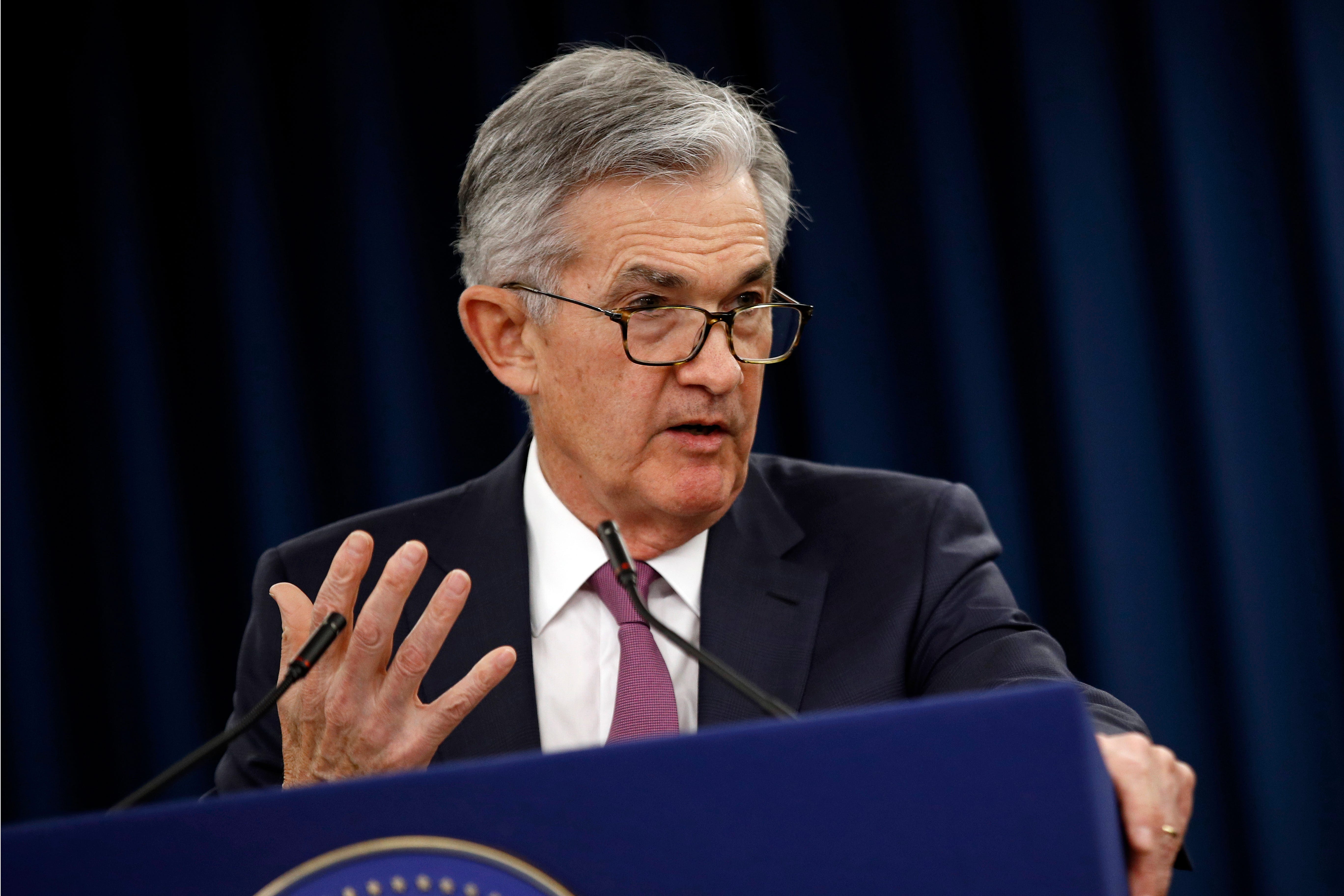
The Fed'south goal: to go along markets performance after they had seized upwardly in fear. The strategy also makes credit easier to obtain, with a bigger money supply and lower interest rates. Without these and the Fed'south other emergency measures, the economy would have crashed already, experts say. Fed Chair Jerome Powell said at a recent news conference that these purchases have helped market conditions better "essentially" in recent weeks.
Fight for survival: Within historic black bookstores' battle to hang on confronting the COVID-19 pandemic
Economy vs. stocks: Here'southward why the market place is better than the economic system right now
But an unstated, practical consequence of the Fed'southward bail purchases is that it creates money to finance the gigantic debt sew by Congress. The very idea of information technology tends to explode the heads of those who say dollars should come from work, savings and investment instead of thin air. In the age of a nearly $25 trillion national debt, such "sound money" concepts seem outdated – relics of a bygone era in which the value of a dollar in one case was based on a fixed corporeality of gold.
"What we're working with now is fake coin, a fake measuring rod," longtime Federal Reserve critic and former Republican presidential candidate Ron Paul told United states of america TODAY. "Information technology is unbelievable."

In this instance, the federal authorities's bank isn't just creating massive amounts of dollars from scratch. The government too is, in effect, using those newly created dollars to pay down its own debt, this fourth dimension at an unprecedented scale considering of the economic system'south massive shutdown triggered by the pandemic.
This might sound like a fiscal fantasy: Yous mean we can pay our credit card bills by simply pressing a push?
Yes, the government can, unlike people and businesses, though information technology's a little more complicated than that. The larger question is whether it's sound and sustainable.
The reply depends on whom you ask and how it'southward managed.
How the Fed injects money into the economy
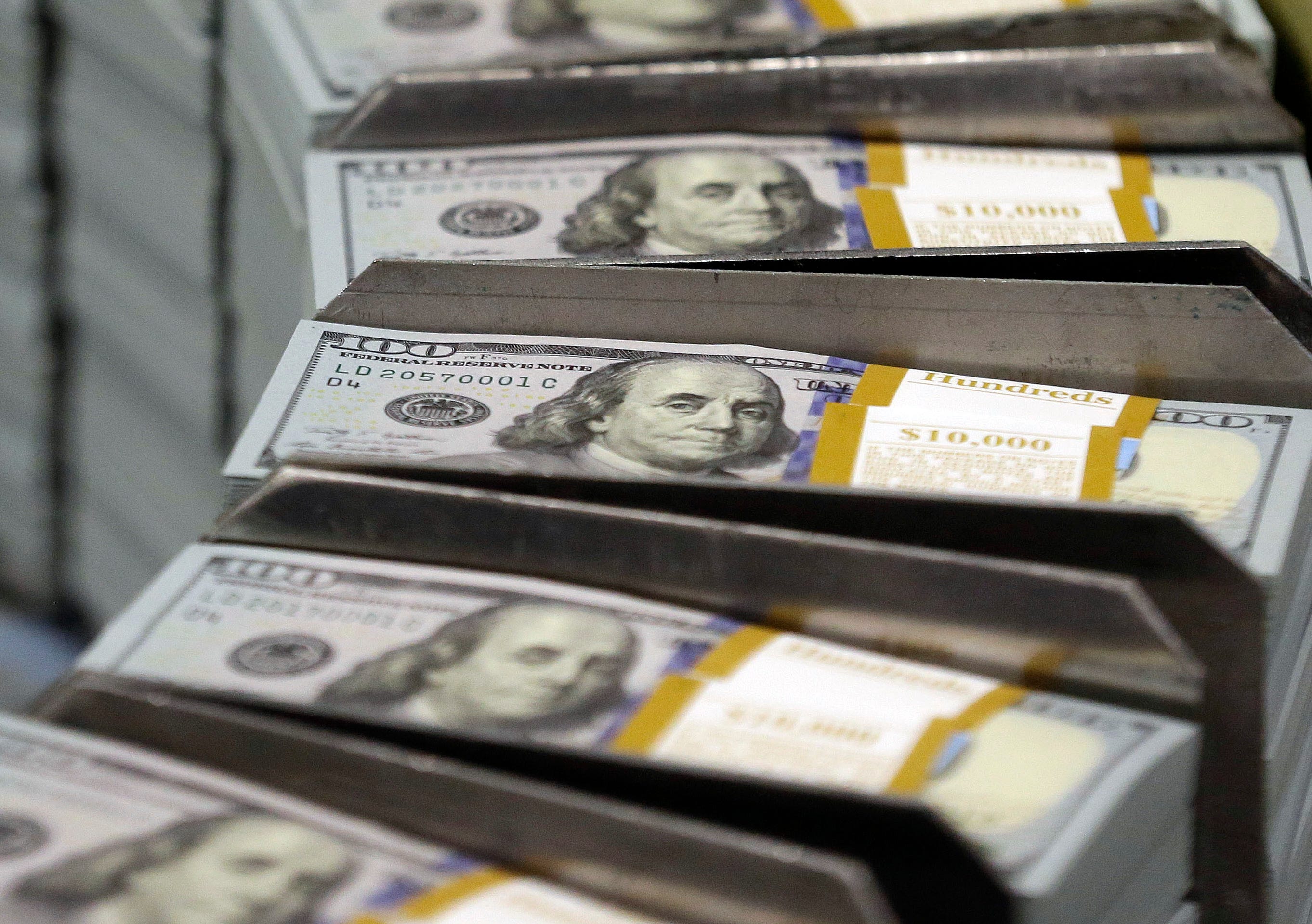
The Federal Reserve doesn't literally impress paper dollars. That'due south the chore of the U.S. Treasury, which also collects taxes and issues debt at the direction of Congress. At this time of crunch, the Fed instead makes large asset purchases on the open up market by adding newly created electronic dollars to the reserves of banks such as Wells Fargo, Goldman Sachs and Morgan Stanley.
In substitution, the Fed receives large amounts of bonds – U.S. Treasury securities and agency securities that are backed by bundles of dwelling mortgages.
Equally a result, markets that had stopped working smoothly started to menses over again. Banks get more than dollars in reserve and are more than prone to lend money without worrying about exhausting their funds because of a run on the banking concern in a time of panic. Such big purchases of securities by the Fed also effectively increment the money supply and drive down involvement rates. This keeps borrowing costs inexpensive for those who demand information technology.
If the Fed didn't take these and other emergency measures, "the organization already would have blown up," said Tim Duy, an economist at the University of Oregon who previously worked in the U.Southward. Treasury. "The markets would have crashed 10 times over."
Separately, Congress recently has passed massive spending bills that have swollen the national debt by nigh $two.4 trillion to assistance businesses and taxpayers. Much of that money comes from issuing U.S. Treasury securities – regime debt that is bought by investors who earn interest on it.
Such foreign and domestic investors endemic most U.S. public debt as of last twelvemonth, with the Fed merely owning fourteen% of it, according to the Regime Accountability Office.
Now the Fed has fifty-fifty more. Since mid-March, the Fed has bought $1.4 trillion in Treasuries – the bulk of the $ane.6 trillion in full Treasuries issued during that catamenia – to thaw out markets that had frozen considering of the electric current crunch, co-ordinate to Oxford Economic science. The Fed, however, doesn't buy securities directly from the U.S. Treasury. Instead, information technology purchasespreviously issued Treasury securities through commercial banks.
In outcome, ane agency of the government – the Fed – is creating dollars to purchase authorities debt in the form of securities previously issued by the U.S. Treasury. The Treasury then pays the Fed what it owes in involvement on those securities. In plough, the Fed is required by law to return to the Treasury the profit information technology makes from the Treasury off of these securities.
"Information technology'south simply kind of a circle in that respect," Duy said.
The same circle also plays a part in the Fed'south unprecedented crisis plan to lend more $2 trillion to businesses, and state and local governments. In this case, the Fed likewise would be creating the money for loans, said erstwhile Federal Reserve vice chairman Alan Blinder, now an economics professor at Princeton.
Fed Chair Powell said he expects the loans to be repaid. But what if some aren't? Does it thing? After all, the Fed can simply push a button to create money.
Blinder said it does affair because the Fed is required to remit to the Treasury the profits it makes on its residuum canvass, which has ballooned by $2.2 trillion to a record $6.7 trillion since mid-March.
"If the Fed would have losses on some of its loans, it would pay less to the Treasury," Blinder said. "The budget arrears would be higher, and then information technology would be as if the Treasury spent more than coin or taxed less."
This is why Congress, through the CARES Act relief and stimulus measure, also has provided $454 billion for Fed programs in case some loans neglect, giving the cardinal bank some political cover in case they practise.
Does 'creating' money create an inflation risk?
Paul, the former Texas congressman and author of "Terminate the Fed," predicts such money creation will lead to disaster. He says it will cause overheated fiscal bubbles fueled by besides much easy money in the system – a chimera that could burst with painful fallout. Creating too much coin that chases likewise few goods also leads to cost inflation, decreasing the purchasing power of the dollar.
But high inflation didn't materialize the terminal fourth dimension the Fed created money on a like calibration as part of its efforts to revive the economic system during and subsequently the Great Recession. To the contrary, an arguably bigger business organization – so and now – has been persistently low inflation, which eventually could lead to deflation, or falling prices, that prompt consumers to put off spending and injure the economic system.
"With the economy so down, and inflation then low, the fears that these kinds of operations will atomic number 82 to high aggrandizement in the United States seem very farfetched," Blinder said.
The crusade of the electric current crunch is a pandemic that forced businesses to shut downwards for weeks, leading both the Fed and Congress to accept extraordinary measures. Congress is approving huge amounts of spending on stimulus and relief while the Fed is creating huge amounts of dollars that end up paying for that debt.
This isn't new, Tcherneva said.
"It's just that now the expenditure is so extraordinary, and because we need to pass a huge budget overnight that we are of a sudden realizing we didn't tax anyone to become this coin, and nosotros didn't borrow information technology from anyone," said Tcherneva, writer of the upcoming book, "The Instance for a Job Guarantee." "The authorities self-finances."
Tcherneva is on the opposite side of the spectrum from Paul. She is a proponent of "Modern Budgetary Theory," which argues that the government tin ever pay its bills by creating more money, minimizing the importance of deficits and debt.
Not every country can exercise this – only those that effect their own currency. And no other country tin can infringe quite like the United States, whose Treasury securities are in need worldwide, largely because they are backed past the "full faith and credit" of the U.S. government, a global superpower with a powerful military. Simply at that place are limits.
`Is there a limit?'
The Fed'south mandate from Congress is to maximize employment and stabilize prices. In doing so, it effectively steps on the gas during times like this and hits the brakes when the economy appears to overheat and prices ascent too fast.
But every bit it tin increase the money supply by creating coin, the Fed tin can also reduce information technology by making moves that increase interest rates, such equally selling some of the securities on its balance canvas, effectively taking coin out of the system.
Going as well far in either direction at the wrong time tin can hurt the economic system. In this economical emergency, the Fed has signaled information technology will do what it takes.
The Fed's "lending facilities are constrained past approval of Treasury, and ultimately Congress holds authority over the Fed," said Duy, who publishes a blog on the Fed called "Fed Watch."
"Simply in theory, the Fed tin can simply continue buying assets," such as Treasury and mortgage-backed securities.
At the same time, Congress's spending still creates debt from the Treasury that has to exist paid back. The Congressional Upkeep Function recently projected the budget deficit will more triple to $3.7 trillion in the electric current financial year, with federal debt held past the public at 101% of gross domestic product. How much debt is besides much?
Powell told reporters that the U.S. has not been on a "sustainable" fiscal path for some time, noting the nation's debt is growing faster than the economy. He added that those concerns now must take a backseat to getting out of this crisis.
Tcherneva downplayed debt concerns in the long term, noting that Japan is still able to service its debt despite having a debt-to-GDP ratio more than double that of the U.S. in contempo years. Japan likewise issues its ain currency.
"We actually don't know how much (debt) is as well much," Tcherneva said. "Is there a limit? If the interest on the debt exceeds the growth of the economy, that could be a trouble."
She said the Fed has tools that tin can aid go on long-term involvement rates below the economy'due south growth charge per unit, though others would say those rates are mostly controlled by the market place.
And, of grade, there's the Fed's magic printing machine.
"The United States can pay any debt it has because nosotros tin can e'er print coin to practice that," former Federal Reserve chairman Alan Greenspan said on NBC in 2011. "And so at that place is zero probability of default."
Eastward-mail reporter Brent Schrotenboer at bschrotenb@usatoday.com. Follow him @Schrotenboer
Source: https://www.usatoday.com/in-depth/money/2020/05/12/coronavirushow-u-s-printing-dollars-save-economy-during-crisis-fed/3038117001/
Posted by: matzwhersuch.blogspot.com
0 Response to "What President Authorized The Printing Of More Money"
Post a Comment